Alinari
- lavora con noi
- contatti
- login
- itaeng
A tribute to Michelangelo. Two photo exhibitions
In 2025, the Fondazione Alinari organized two photographic exhibitions dedicated to Michelangelo, the absolute icon of Renaissance art, in the year of the 550th anniversary of his birth.
The exhibitions, held in Carrara and Florence, presented a selection of images from the Alinari Archives that documented the work of Michelangelo Buonarroti. The exhibitions brought together significant examples of historical photography from the Alinari, Brogi and Anderson studios, three companies that made a decisive contribution to the international dissemination of Italian art and Michelangelo's genius from the mid-19th century onwards for over a century.
The two exhibitions were then brought together in a single catalog, published by Sillabe.
Marble giants

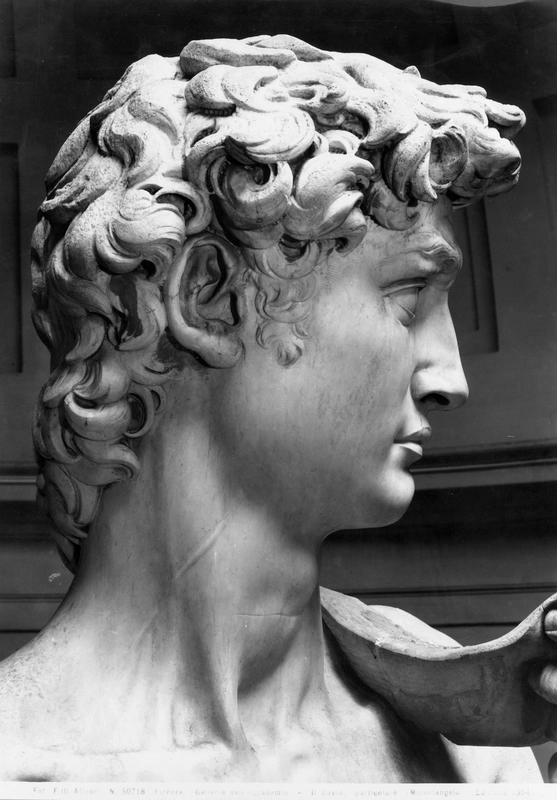

In 1504, David was unveiled to the Florentines: “that statue which stands today before the door of the Palazzo della Signoria, at the end of the railing, called by all the Giant.” A universally recognized icon, it is the work with which, according to Vasari, Michelangelo surpassed the ancients.
But how can we present today, among the many archive photographs available, the work that is perhaps the most copied and reproduced in the world, an image so recognizable, so enormously used and in some ways “abused”? And how would Michelangelo have wanted his David to be seen, appearing rigid in some photographs and extraordinarily mobile in others?
We have chosen to represent David through three details of his face from the Alinari and the Anderson Archive, taken at different times. Three photographs that bring us almost face to face with the young giant and, in some way, explain the conceptual value of this famous work: here Michelangelo chose to represent not an action, but the intangible moral and intellectual values that precede action.
Glass giants

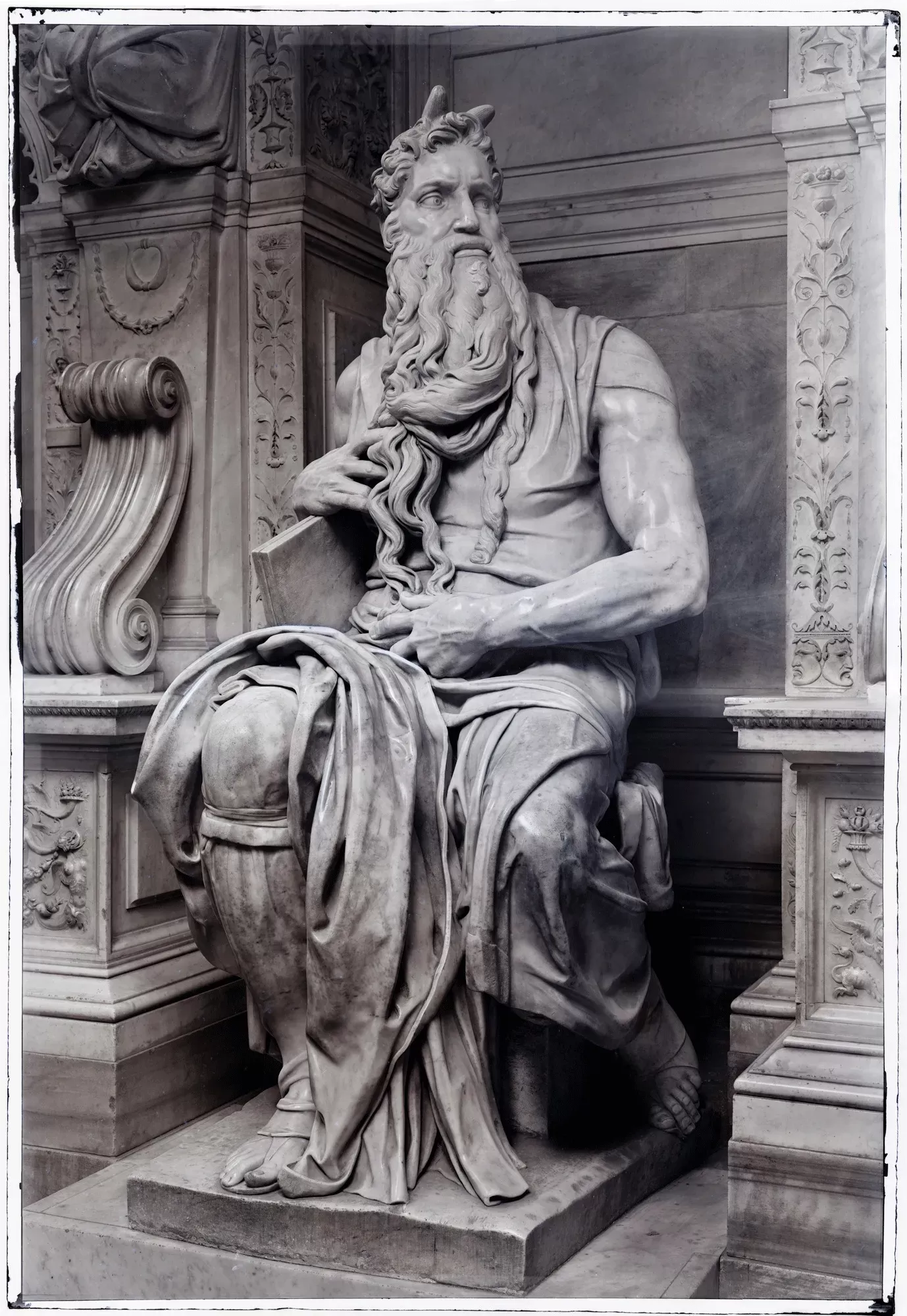


“The Alinari brothers always managed to stay at the forefront of every advancement [...] and they also produced reproductions of the most sought-after paintings in our galleries, in sizes that had never been attempted or even imagined before, as it involved preparing plates measuring up to one meter and fifteen centimeters in height and eighty-five centimeters in width.” In 1890, art critic Diego Martelli praised the work of Giuseppe Alinari, an experimenter with great technical knowledge who is credited with the invention of these glass giants.
The exceptionally large negative plates, preserved in the Alinari Archives, are a unique heritage in the world. A study and restoration project has been launched on 170 works to clarify production methods and techniques. These plates made it possible to obtain large-size contact prints: a complex challenge for the time.
The Alinari and Michelangelo
.webp "ACA-F-002703-0000-invertita%20%281%29")


“The mere name of Michelangelo is enough to send all modern artists into retreat.” This is what Leopoldo Alinari wrote in 1855. The artist's works, which were already legendary in his lifetime, would become a preferred subject and a testing ground for the technical experimentation of Fratelli Alinari in their early days.
During the period when the company was led by its founder, Leopoldo (from 1852 to 1865), and subsequently by his brothers, Giuseppe and Romualdo (from 1865 to 1890), subjects inspired by Michelangelo rapidly increased.
From the time of Vittorio Alinari's leadership (1890–1920) onwards, the company's industrial expansion required the establishment of criteria to ensure the quality and recognisability of the Alinari brand. These criteria were adhered to throughout the first half of the 20th century, remaining faithful to the Alinari "style", which even when photography became fully aware of its expressive capabilities, continued to focus on the subject without dramatic contrasts of light or framing.
Whether photographing a work in its entirety or a detail, the Alinaris seem to let Michelangelo speak to us without "intermediaries".
Brogi and the sculptures of the New Sacristy

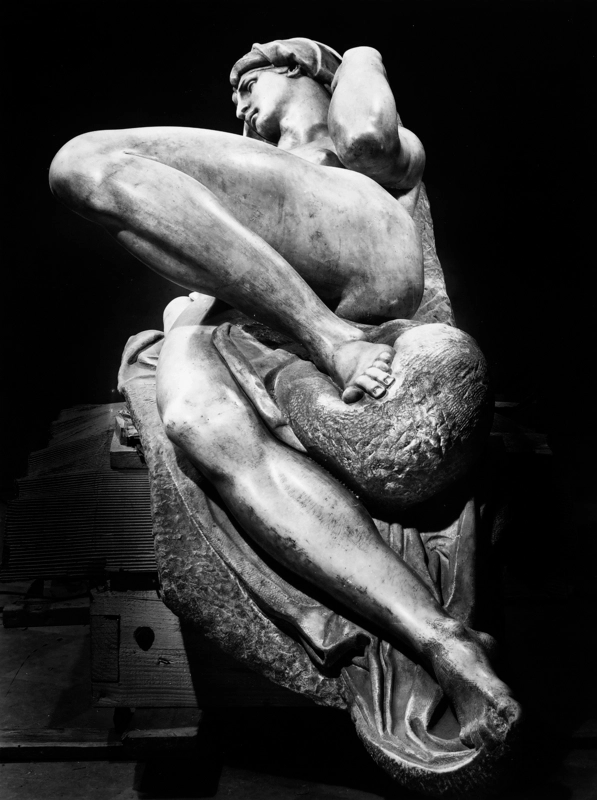


Italy entered the war on 10 June 1940. Between 1940 and 1943, Michelangelo's sculptures from the New Sacristy in San Lorenzo were removed from their original location for safekeeping and transported to Villa della Torre a Cona, in Rignano sull'Arno, where they remained until November–December 1945.
Having the opportunity to photograph Michelangelo's sculptures from the ground, examining them from every angle and highlighting details that are normally invisible, was a particularly significant moment.
Brogi's photographic campaign transcends the mere purpose of documentation. The singular vision of the work is shattered into a variety of different perspectives. Against a black background, isolated from contextual elements, the sculptures are multiplied in sequences, offering a reinterpretation of these masterpieces.
The quarries of Carrara in the Corsini archive


Although Michelangelo lived and worked in Florence and Rome, Carrara, with its quarries, was also a place of great significance for the artist. We can imagine the creative genesis of so many masterpieces from those blocks of pure white marble, which were personally selected on site with the help of local stonemasons and quarrymen.
The archive of Augusto Corsini was chosen to document the quarries of Carrara, immortalising them in views that highlight the changing landscape, the hard work involved in extraction, processing techniques and transport methods. Together, these images provide a social cross-section of Carrara in the first half of the 20th century.
To see Michelangelo


Michelangelo's works must have raised many questions regarding the technical and aesthetic decisions required for their reproduction within the confines of a two-dimensional photographic print.
While the Alinari brothers had achieved a high level of mastery in photographing architecture and sculpture since the 1850s, developing criteria for photographing paintings was more complex. This was because paintings required artificial lighting and, in monumental contexts, scaffolding to reach subjects at great heights. An extraordinary backstage photograph taken by the Alinari brothers during their 1904 photographic campaign in the Sistine Chapel is a rare example of this. It features monumental scaffolding on wheels and an internal ladder on which the large camera stands.
The education of Florentine photographers, informed by the works of the Tuscan Renaissance — including Michelangelo's drawings, which were preserved in the Uffizi and photographed in the 1850s — led them to prioritise figures over landscape elements when reproducing paintings.
The Anderson photographic studio produced some truly impressive work in the Sistine Chapel. Domenico Anderson produced more than 400 negative plates, first starting in 1882, then again between 1898 and 1904.

 Le attività sono realizzate grazie al contributo concesso dalla

